

Tiling an outdoor front door patio can be a great way to add curb appeal to your home. Patterned tile in particular can make a wonderfully dramatic entryway or back patio entertainment space. However it can sometimes be tough to decide among all the possible patio tile design options. You also need to think about durability (making sure the tile doesn’t crack) and safety (slips and trips are bad) when designing for the long term.
Here is how I performed a custom front door patio tile design install at a home in south Austin, TX, that took all these factors into account. My clients chose a very strongly patterned tile that needed some creative design to seamlessly integrate with the rest of their modernist house look. I’ve descibed in a previous post how to install outdoor patio tile with a proper crack prevention membrane. This post focuses on how to evaluate patio design options for choosing the best look for your home.
The Before
Even multimillion dollar homes often still have bulder grade finishes. This house was in the Zilker neighborhood of Austin, TX, and had lots of style to match the swanky zip code. What it didn’t have, however, was an appealing entryway. The front entrance patio was just a bare slab of concrete.


These folks wanted a patio with some pizazz. But they also wanted a practical patio that would be safe, easy to clean, and durable.
The Considerations
You can get all these things (safety, low maintenance, and durability) with ceramic tile.
For safety, it’s important to choose matte finish tile for slip resistance and a pattern layout that makes it easy to see steps. This will keep your insurance agent happy.
For low maintenance easy cleaning, you want to use a dense pre-sealed sanded grout (Mapei’s “Ultracolor Plus FA” is my favorite). Even dense pre-sealed grout isn’t waterproof, but it will be water resistant and therefore stain resistant.
And for durability, it’s important to use a properly installed crack prevention membrane anytime you’re installing tile outdoors. Tile and concrete expand and contract at different rates when outdoor temps go up and down. This is why you need something between the surface tile and concrete slab to prevent these stresses from cracking the tile in freezing winters or superhot summers (ATX gets both).
That’s all there is to ensuring a great patio tile result. Simply find a ceramic or porcelain tile you like that has a matte finish and a size/shape/pattern that can fit your patio dimensions. Then just be sure to use an anti-fracture membrane and a quality presealed dense sanded grout. Easy peasy!
The Design
These clients chose a very strongly patterned black and white octagonal tile for their project.

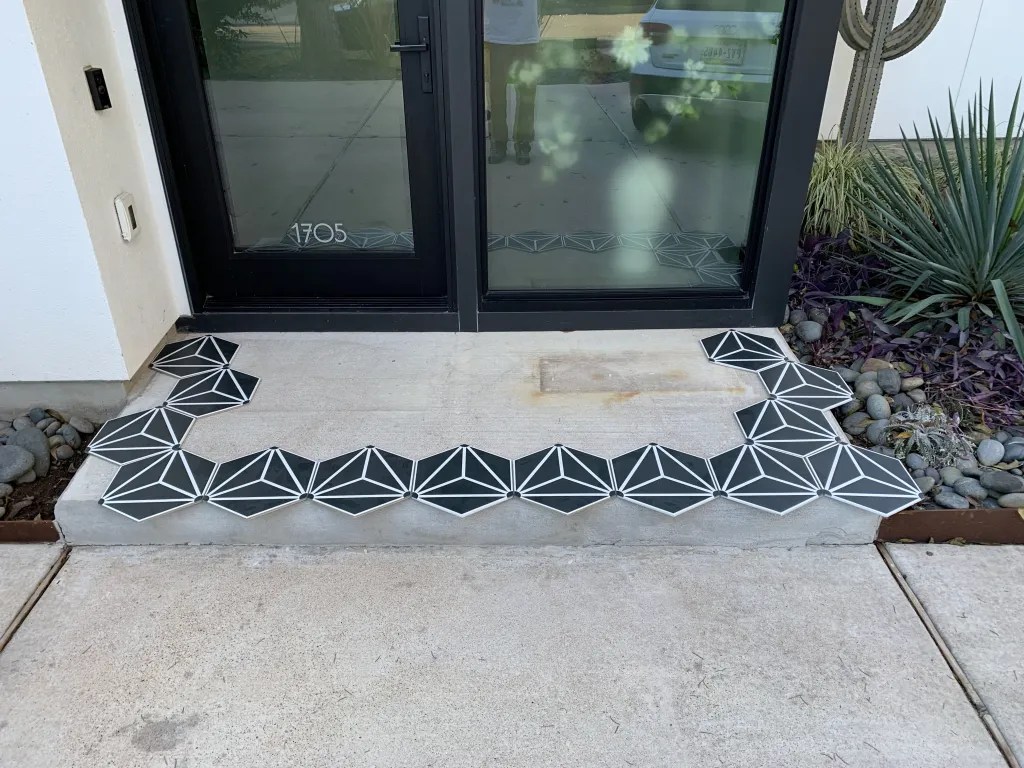

This required some extra careful preplanning to make the overall patttern look centered and purposeful. It’s also important to preplan a patio tile design for safety anytime steps are involved.
For example, it is important to use a different tile for the vertical patio edges. Wrapping a strongly patterned tile around a patio perimeter can result in a serious tripping hazard.


It is also important to preplan where each individual tile will go, and to label each tile so you don’t get confused while installing them. This is helpful even for seemingly simple designs. Preplanning and precutting each tile will make the actual installation go much more quickly and smoothly.
The Installation
Speaking of, here are some pics of the installation process from initial cleaning to final grouting. You can read more about the specifics of how to install outdoor patio tile in this detailed blog post. Here are just a few picture highlights from this particular job:


This patio tile design used flat black porcelain tile along the vertical front and sides of the patio for a clean modernist look. The clients also chose to use black grout for the perimeter tile and white grout for the white patterned field tile. These choices kept the strong geometric pattern a little muted to match the clean modernist aesthetic of the house design.
The Finish
There is a rule of threes in any design. Fewer than three elements tends to make a design look boring. More than three strong elements will often make a design look too busy. So, it’s a good idea to stick with three.
In this design, the three strong elements were COLOR (contrasting black with white), PATTERN (the striking geometric field tile), and CONTRAST (using a patterned tile in front of a muted modernist cube home facade).


There are a near infinite number of patio tile design options to choose from when combining tile sizes, shapes, patterns, colors, etc. Sometimes this can seem overwhelming. But sometimes the best design option is to just keep things simple with three basic decisions.
Simply focus on making a statement with one element (in this case, the eye-catching geometric pattern). Then, just pick two more complementary elements to prioritize (in this case, the white/black contrast and the flat black front porcelain tile wrap to match the rest of the home design).
Whatever design you chose, just be sure to make sure your patio will be safe, easy to maintain, and durable. You can do this by simply using a ceramic or porcelain tile with a matte finish, quality pre-sealed grout, and an anti-fracture membrane.
The result will make any client happy!
Read this client's review